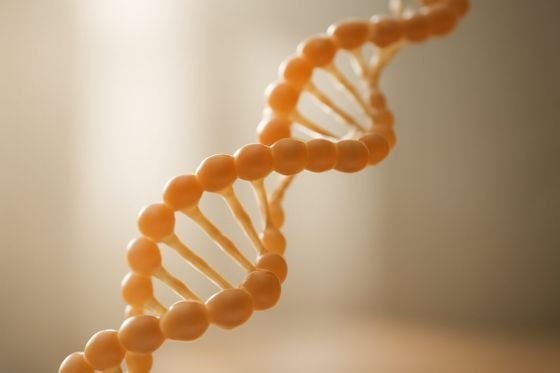
Epithalon is a four amino acid synthetic peptide (Ala-Glu-Asp-Gly) based on a pineal gland substance, studied mainly for its effect on telomeres and aging markers. The strongest findings come from cultured human cells, where it raised telomerase activity and extended telomere length. It is not an FDA-approved drug for any use, human outcome data is limited, and most of it traces to one Russian research group. That combination is the whole story for a beginner: an interesting signal in the lab, and a much smaller pile of evidence in living people.
Where did epithalon come from?
The peptide grew out of Russian work on the pineal gland, the small structure that produces melatonin and appears to change measurably with age. Researchers there described a shorter peptide, epithalon, as a synthetic version of a natural pineal extract. Reviews of pineal aging trace how the gland’s function shifts over a lifetime and frame epithalon as an attempt to counter part of that shift, an idea laid out in work on the morphofunctional bases of pineal aging.
That origin matters because it explains both the appeal and the caution. The concept is grounded in real biology of an organ that does decline with age. But the body of research is narrow, produced largely by the scientists who developed the compound, and independent replication remains sparse.
What does the telomere research actually show?
The most cited results are cell culture experiments. In human somatic cells, epithalon induced telomerase activity and lengthened telomeres, and related work reported that the peptide let cells push past their normal division limit, the so-called Hayflick limit. A more recent analysis again describes telomere elongation through telomerase upregulation or an alternative lengthening pathway. Taken together these are consistent, repeated laboratory observations.
They are also, importantly, laboratory observations. A cell in a dish that keeps dividing is not the same as a person living longer or healthier. The leap from telomerase activity in culture to anti-aging in humans is exactly the leap the current evidence does not fully make. Reading the cell findings as proof of longevity is the single most common mistake in beginner materials on this topic.
How does epithalon compare to the claims around it?
| Claim commonly made | What the research supports | Gap |
|---|---|---|
| Lengthens telomeres | Yes, in cultured human cells | Cell data, not confirmed human outcomes |
| Raises telomerase activity | Yes, repeatedly, in vitro | Mechanism shown, benefit not established |
| Extends human lifespan | Small follow-up studies from one group | Not independently replicated at scale |
| Restores pineal and hormonal rhythm | Animal and limited human signals | Early, not a proven clinical effect |
Is there any human data at all?
There is some, and it deserves a fair hearing. A 15-year follow-up of elderly patients reported that a pineal peptide preparation was associated with lower mortality over the study period, framed by the authors as a geroprotective effect. Other work looked at melatonin and pineal peptides correcting impaired reproductive cycles, and a study on short peptides examined links to the telomere-related hormone irisin.
These are worth reading, but their limits are real. Sample sizes are modest, the same research network appears again and again, and the strongest human study is decades old. That is not proof of fraud, it is simply thin evidence. A beginner should treat the human data as suggestive rather than settled.
Is epithalon approved or regulated?
No. Epithalon is not an FDA-approved product for any indication. There is no reviewed label, no approved dose, and no standardized manufacturing behind a pharmacy version. Much of what circulates online is sold as a research chemical, which means purity and contents are unverified and there is no accountability for what is in the vial. That uncertainty is a safety issue in its own right, separate from any question about whether the peptide works.
This is where compounded preparations enter the conversation. A compounding pharmacy can prepare a peptide to a prescriber’s order, but a compounded product is still not FDA-approved and has not been through the review process behind approved drugs. It removes some of the sourcing chaos of research-chemical sellers without adding regulatory approval.
How do access and cost usually work?
Because no approved product exists, insurance is not part of the picture, and every route is out of pocket. Prices vary widely by source and quality, and the cheapest research-chemical listings are cheap for reasons that should give a beginner pause. The practical decision is less about the lowest number and more about whether a licensed clinician is involved in the prescribing and whether the source is traceable.
A small number of supervised telehealth practices offer peptides like this as compounded preparations with a clinician in the loop; one of them, FormBlends, publishes what the process and pricing look like if you want to read the full breakdown before deciding whether the route is worth it. Others in the broader telehealth field, such as Ro, Hims and Hers, or Henry Meds, focus on approved medications rather than experimental peptides, which is a distinction worth keeping straight.
Is epithalon worth trying?
For most people, the honest answer is not yet, and possibly not at all at current evidence. The mechanism is genuinely interesting and the cell data is real. But the jump to proven human benefit is not supported, the product is unapproved, and quality control in the open market is poor. If someone still wants to explore it, doing so with a prescriber who knows the person and the sourcing beats buying an unlabeled vial online. Anyone who sees it marketed as a proven fountain of youth is being sold ahead of the science.
Key takeaways
- Epithalon’s strongest evidence is telomerase activity and telomere lengthening in cultured human cells.
- Human outcome data is limited and comes mostly from one research group.
- It is not FDA-approved, and research-chemical sourcing carries real purity risks.
- Compounded versions involve a clinician but are still not approved products.
- The gap between cell findings and proven human anti-aging is the thing to understand first.
Frequently asked questions
What is epithalon?
Epithalon is a short synthetic peptide of four amino acids, modeled on a substance from the pineal gland. Most interest in it centers on laboratory findings that it can raise telomerase activity in cultured human cells.
Is epithalon approved by the FDA?
No. Epithalon is not an FDA-approved drug for any use. Much of the published work comes from a single Russian research group, and there is no approved product carrying reviewed labeling and dosing behind it.
Does epithalon actually lengthen telomeres in people?
The clearest evidence is from cell cultures, where the peptide raised telomerase activity and extended telomeres. Human outcome data is thin and comes mostly from small studies by the same group, so the cell findings should not be read as proven longevity in living people.
How do people obtain epithalon?
There is no pharmacy-stocked approved version. Some is sold as research chemical of uncertain quality, and some is offered through supervised telehealth as a compounded preparation, which is still not an FDA-approved product.
What should a beginner check first?
Whether the evidence supports the specific claim being made. Much marketing implies proven human anti-aging, while the strongest data sits in cell lines. Clarifying that gap first prevents paying for a promise the research does not carry.